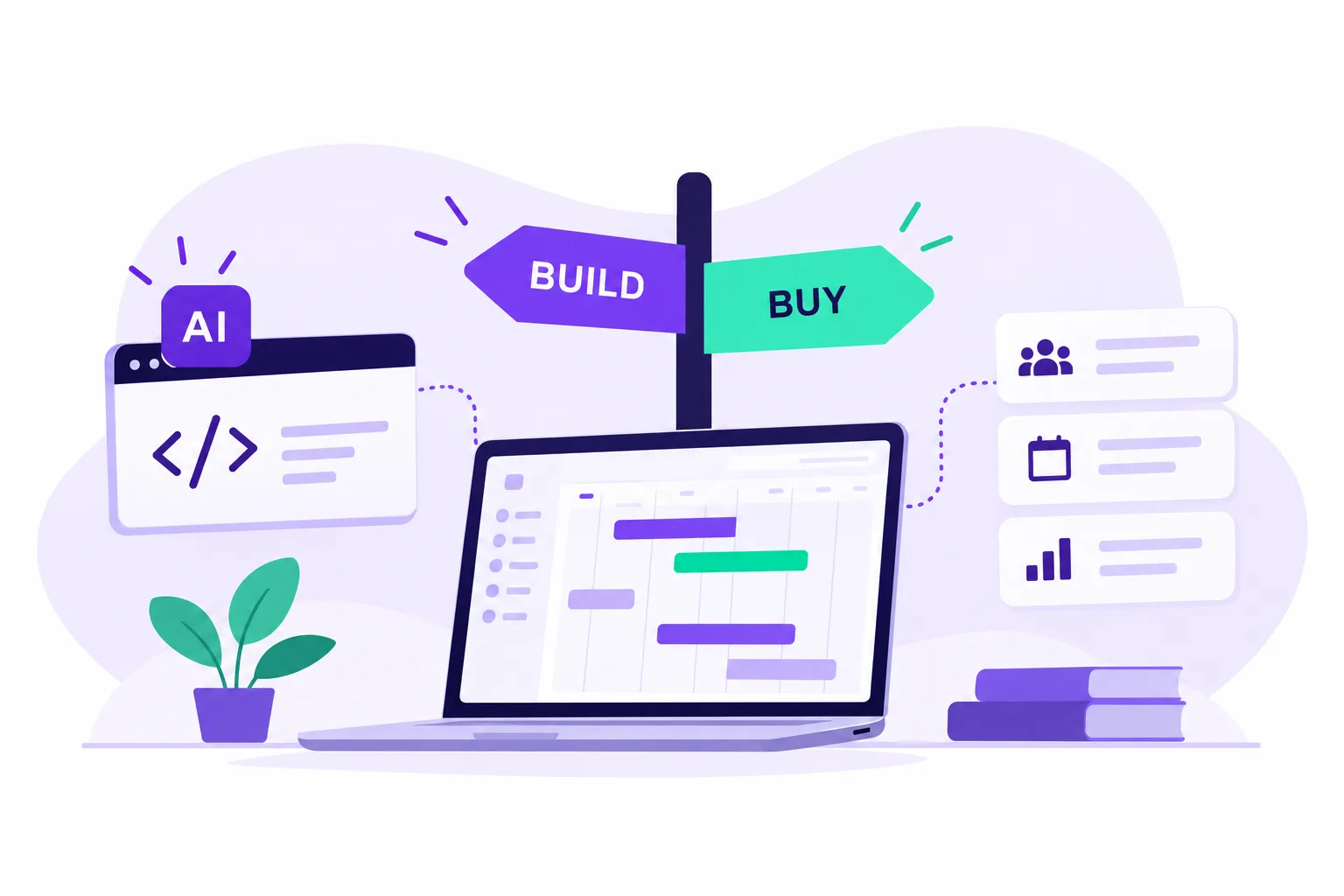
With AI, you can build a first version of a planning tool in a short space of time. That has changed the question around our table. It’s no longer just about whether you can build something yourself, but above all which parts you actually want to own afterwards.
Here’s an example of how that conversation goes. Sitting across from us is an entrepreneur who runs a steel company with 46 employees and two sites. With the help of AI, his son built a first version of a planning tool in two evenings, perhaps secretly taking a little inspiration from how vPlan works and its look & feel. 😉 It’s still a long way from having all the features and logic of a mature planning solution, but it’s enough to put employees and jobs on a timeline and move them around.
And to be fair: that’s impressive. Something that would have quickly become a serious software project just a few years ago suddenly feels surprisingly within reach. So why pay for off-the-shelf software when it’s becoming easier and easier to build something yourself?
It’s a fair question. Building software has become cheaper and more accessible, which also makes custom software an attractive option again. In our view, however, the choice isn’t as simple as building it yourself or buying software. The more interesting question is which parts you buy as standard and which parts are so specific to your business that you’re better off building them yourself.
What AI has really changed
Custom software was expensive and time-consuming for a long time. Even for a relatively small application, a business case had to be made, a developer found and sometimes months spent waiting. Not because custom software didn’t offer value, but because the costs and maintenance often outweighed the benefits. AI is changing that balance.
Work that used to involve a lot of manual programming can now be done much faster with AI. Building screens, creating test data, writing integrations, producing documentation and translating existing patterns into working software. As a result, applications that would simply have been too expensive to develop a few years ago are now becoming viable.
Of course, this development applies to us too. At vPlan, we make extensive use of AI in our development processes to develop faster, review code, create tests and turn ideas into working functionality more quickly. So the same technology that makes custom software more accessible also helps off-the-shelf software evolve faster.
The misconception, therefore, isn’t the enthusiasm for building software yourself, but what you think you have once the first version works. With AI, you can build a house faster and faster, but once you move in, the heating needs to keep working, leaks need to be fixed and the house needs maintenance. Software is no different.
What you own once it goes into use
As soon as software becomes part of your day-to-day operations, a different kind of responsibility arises. Two planners might edit the same order at the same time, an integration might stop working because a supplier changes its API, and a backup is only useful if you can actually restore it. These aren’t the things that make an initial demo more appealing, but they do determine whether people can rely on the software every day.
The software itself also continues to change. New employees, processes, requirements and integrations are added. After a few years, a small change can have consequences for all sorts of other areas. That applies to any software solution, but when you build it yourself, you organise and pay for that maintenance yourself.
Why custom software is becoming attractive again
That’s not an argument against building anything yourself. Quite the opposite. Precisely because AI reduces development costs, it’s becoming more attractive to build software for processes that are genuinely specific to your organisation.
Take the steel company again. Perhaps material thickness, cutting time, changeover time and its own rules for leftover material determine which machine a production order is best planned on. That’s specific business knowledge where custom software can add a great deal of value.
But for that one clever calculation, the company still needs employees, machines, rotas, capacity, orders, permissions, history, mobile access, security and integrations. Why rebuild that foundation when the calculation itself is the part that sets the business apart?
That’s where we see the opportunity: use off-the-shelf software for what is the same for many businesses and custom software for what makes your process different.
But custom software also comes with responsibility
AI makes custom software much more attractive. But that doesn’t automatically eliminate the risks that come with it. In fact, because you can now create something that works so quickly, it’s easier to overlook those risks at the outset.
| Custom software risk | What does this mean in practice? |
|---|---|
| Dependency on knowledge | Often, only a small number of people know how the solution was built and why certain choices were made. If that knowledge is lost, making changes and fixing issues becomes more difficult. |
| Maintenance & ongoing development | Processes change, new requirements emerge and technology becomes outdated. The software needs to keep evolving alongside them. |
| Continuity | In the event of a failure, someone needs to be able to intervene. Monitoring, backups and recovery therefore need to be properly set up and tested. |
| Security & Privacy | Permissions, updates, vulnerabilities and personal data need to be managed properly on an ongoing basis. |
| Groeiende complexiteit | What starts as a small application can gradually grow into business-critical software as new features, exceptions and integrations are added. |
These aren’t reasons not to use custom software. But they are reasons to think carefully about which parts you want to own yourself. For specific business logic, the benefits of custom software can far outweigh these risks. For functionality that hundreds of other businesses also need, the considerations are different.
Make sure you calculate the full cost
If you’re considering building your own software, you should look at least three years ahead. Don’t compare €300 a month for software with just €7,500 in development costs. With SaaS, your licence also covers hosting, backups, security, support, monitoring, maintenance and ongoing development. Those costs don’t disappear when you build your own software; you simply have to manage them yourself.
A simplified comparison over three years might look something like this:
| Cost item | vPlan | Build your own |
|---|---|---|
| Licence | € 300 p/m x 36 = € 10.800 | - |
| Implementation | € 2.500 | - |
| Initial development | Included | € 7.500 |
| Hosting and infrastructure | Included | € 1.800 |
| Backups and monitoring | Included | € 900 |
| Security and updates | Included | € 1.800 |
| User support | Included | € 1.800 |
| Maintenance and minor changes | Included | € 14.400 |
| Ongoing development of the standard product | Included | Eigen verantwoordelijkheid |
| Total over 3 years | € 13.300 | €28,200 + ongoing development |
These are example figures and the outcome will vary from one organisation to another. The most important thing is to compare like-for-like costs. Internal hours in particular are easily overlooked: four hours of maintenance per month at €100 per hour already adds up to €14,400 over three years. You see the SaaS licence on an invoice every month, whereas internal time is much less visible.
Buy the foundation, build the difference
Custom software doesn’t have to be an alternative to vPlan. Suppose the steel company builds its own smart machine calculation for €5,000. That calculation could also be added on top of an existing planning tool. So, having a specific requirement doesn’t automatically mean you need to build the entire application yourself.
That leads to a fairly simple distinction. Buy the foundation: planning, capacity, employees, machines, rotas, permissions, mobile access, integrations, backups, security and management. Build the difference: the logic, automation or AI application that is specific to the way your organisation works.
APIs, integrations, automation and AI are making this combination increasingly easy. As a result, the choice is shifting from build versus buy to, increasingly, build and buy.
One simple question can help: could I sell this to my competitor too? A planning board, user management or capacity calculation probably could be. Your own production logic, specific inspection process or unique way of working probably couldn’t. That latter part is precisely where there is room for custom software.
Before you start
If you want to build your own software, decide in advance who will maintain it in three years’ time, what a day without planning would cost and what happens if the person with the most technical knowledge leaves. Above all, ask yourself which part of the solution is genuinely specific to your business and whether you can build just that part.
AI makes it easier and cheaper to develop your own software. In our view, that’s an opportunity businesses should embrace. But custom software no longer has to mean building everything yourself.
Buy what’s standard. Build what sets you apart.

Work at vPlan
We are looking for new colleagues.