How often do you ask your colleague, "What are you currently busy with?" Avoid rolling eyes, sighs, and unnecessary questions. Not every meeting needs to start with boring updates. Everyone should already know exactly who is working on what, at any given moment.
If your organization isn't familiar with it yet, it's time to use the Kanban method.
What is Kanban?
Kanban is a visual method for managing and planning work. It's a flexible, effective, and simple approach to planning. It often consists of one workflow of To Do, In Progress, and Done, but it also facilitates:
- Better visibility by enabling everyone to show how work moves through the flow.
- Improved efficiency by removing bottlenecks and too much work in progress.
- Improved efficiency by removing bottlenecks and too much work in progress.
- Higher predictability as work flows through fixed lanes. Effective collaboration through transparency and continuous encouragement to finish work.
- A stronger company culture by promoting trust, respect, and leadership at all levels.
Kanban originated in Japan. The method was developed around the 1940s by Taiichi Ohno, an engineer who worked for Toyota. He is also the founder of the LEAN production philosophy, which is still used by many manufacturing companies today.
Ohno devised the method based on the process of a supermarket. Supermarkets manage their inventory by having enough products to meet consumer demand. Ohno introduced a similar approach within Toyota. It worked as follows:
- Employees on the shop floor communicated capacity levels in real-time by passing a physical card between teams.
- When materials ran out in production, a card was passed to the warehouse to inform them of what was needed.
- Based on this information, the warehouse conveyed the requirement to the supplier.
- The supplier delivered the demand to the warehouse. The warehouse then supplied the team needing the materials.
This methodology is now also known as the 'Just-in-Time' production process. From the manufacturing industry, the Kanban method has been adopted by other industries, such as software developers.
Kanban in vPlan
It's also possible to plan with the Kanban method in vPlan. Create a status for each step in the planning board. Think about how work flows through your organization.

In this example, let's take a look at a software development process with the following steps: To Do, Development, Review, Testing, and Deployment. For each step, we create a status with a color in vPlan.

Each card you create on the planning board starts at the first status, To Do. A card corresponds to a task, in this case, the functionality to be developed. The card contains all the necessary information to carry out the task. The goal is for the card to move from left to right on the board.

Assign your employees to tasks to give them responsibility for the tasks to be performed. When an employee starts a task, they can simply drag it to In Progress. And so, all cards go through the workflow, and you know the status of each card.
What other benefits does vPlan have?

Capture all information in a card. From attachments to custom fields.
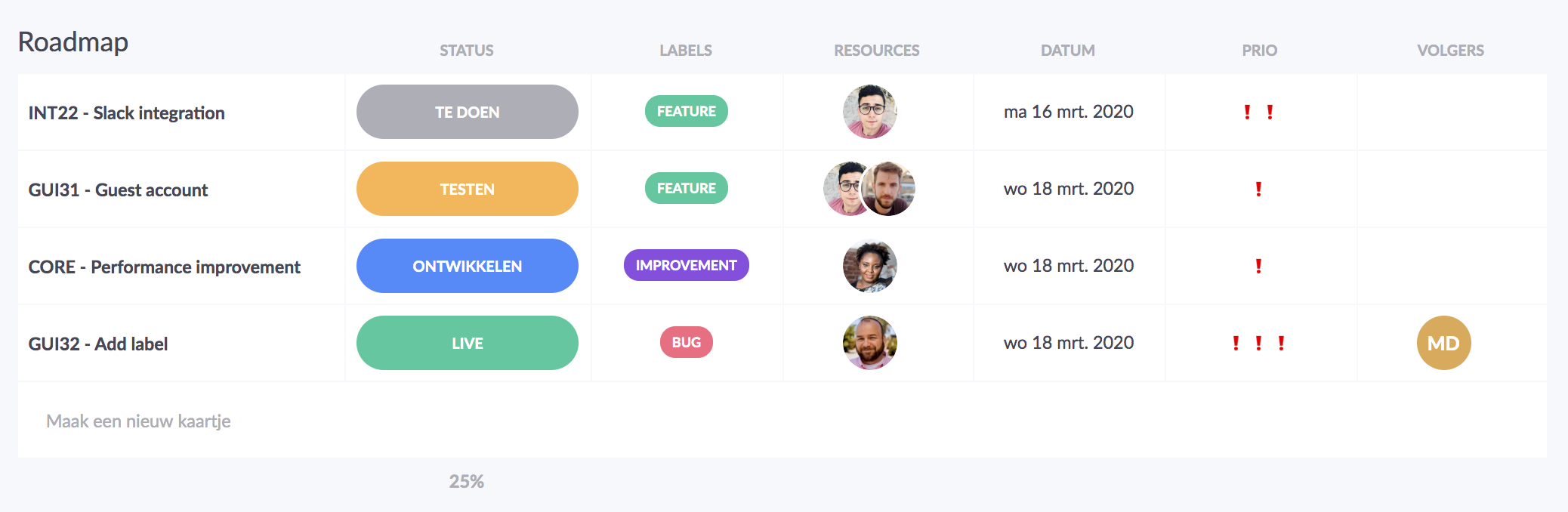
View the planning from different perspectives, such as the list view. You can quickly access the planning from various viewpoints, such as employee or deadlines. Choose which information you want to see in the list.

Communicate with your team. This way, you won't have unnecessary email or WhatsApp traffic. You'll receive automatic notifications via email or within the message center in vPlan.

Work at vPlan
We are looking for new colleagues.